
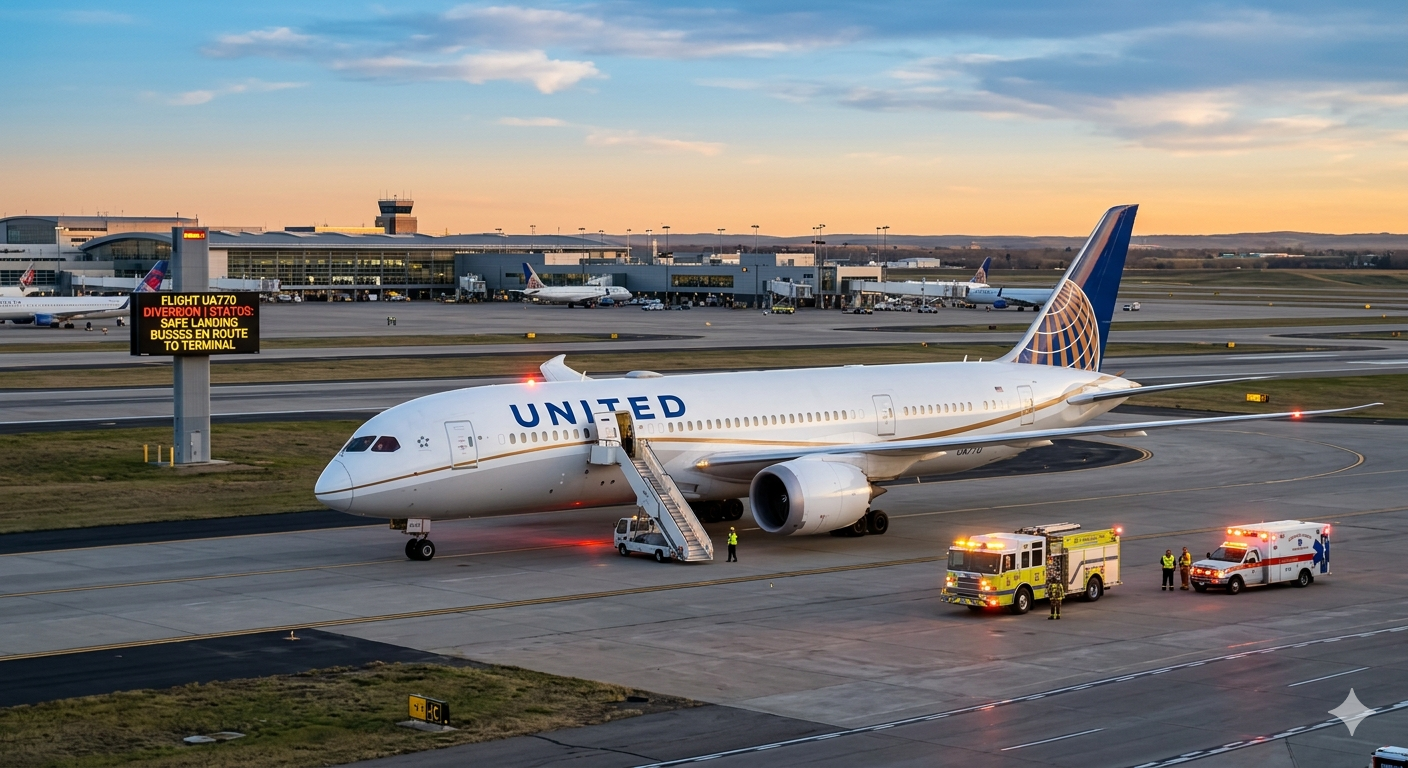
Aviation is often described as hours of boredom punctuated by moments of sheer adrenaline. For those aboard the United Airlines flight UA770 emergency diversion, that adrenaline became a reality when a routine journey took an unexpected turn. While air travel remains the safest mode of transportation globally, “emergency” is a word no passenger ever wants to hear over the intercom.
The United Airlines flight UA770 emergency diversion serves as a fascinating case study in modern aviation safety. It highlights the complex interplay between pilot intuition, advanced aircraft sensors, and the rigorous protocols that keep the skies secure. In this article, we’ll break down exactly what happened, why these diversions occur, and what it means for the future of United Airlines’ fleet maintenance.
What Happened During the United Airlines Flight UA770 Emergency Diversion?
Every flight follows a strict “flight plan,” but Mother Nature and mechanical components don’t always check the schedule. The United Airlines flight UA770 emergency diversion occurred when the flight crew identified a technical anomaly that required immediate attention. Rather than pushing through to the final destination, the pilots made the tactical decision to land at the nearest suitable airport.
The Timeline of the Incident
The flight originally departed with standard expectations. However, shortly into the cruise phase, sensors indicated an issue—often reported in these scenarios as a hydraulic pressure drop or an engine performance variance.
-
Initial Detection: Sensors alerted the cockpit to a non-standard reading.
-
Pilot Assessment: The crew consulted their Quick Reference Handbook (QRH).
-
Communication: Air Traffic Control (ATC) was notified of the “Squawk 7700” status.
-
Safe Landing: The aircraft touched down without further incident, met by emergency ground crews as a standard precaution.
Why Denver or London?
Depending on the specific date of the United Airlines flight UA770 emergency diversion, the aircraft has been known to divert to major hubs like Denver (DEN) or London Heathrow (LHR). These airports are chosen because they offer extensive maintenance facilities and “long-haul” runways that can accommodate heavy aircraft landing with significant fuel loads.
Common Causes for a United Airlines Flight UA770 Emergency Diversion
When we talk about the United Airlines flight UA770 emergency diversion, it’s important to understand the “why.” Aviation enthusiasts and nervous fliers alike often wonder what could force a massive Boeing or Airbus jet to change course.
1. Mechanical and Technical Malfunctions
The most frequent cause for a United Airlines flight UA770 emergency diversions is a mechanical hiccup. Modern planes are incredibly redundant, meaning they have backups for their backups.
If a primary hydraulic system fails, the plane can still fly. However, safety regulations often dictate that the plane must land if that redundancy is lost. This is exactly what happened in several high-profile United incidents throughout late 2024 and early 2025.
2. Engine Issues and Performance
Engine “flameouts” are rare, but “performance issues” are more common. If an engine isn’t producing the exact thrust required or if oil pressure fluctuates, the United Airlines flight UA770 emergency diversion becomes the safest path forward. Pilots are trained to treat even a slight vibration as a reason to seek a landing strip.
3. Medical Emergencies on Board
Not every diversion is about the machine. Sometimes, it’s about the people. If a passenger experiences a cardiac event or a severe allergic reaction, the United Airlines flight UA770 emergency diversions is initiated to get that individual to a hospital as quickly as possible.
The Role of “Squawk 7700” in Flight UA770
If you follow flight tracking apps like FlightRadar24, you might have seen the United Airlines flight UA770 emergency diversion highlighted in red. This happens when a pilot “squawks 7700.”
What is a Squawk Code?
A squawk code is a four-digit number assigned to a transponder.
-
7500: Hijacking (Unlawful Interference)
-
7600: Radio Failure (Lost Communications)
-
7700: General Emergency
By selecting 7700 during the United Airlines flight UA770 emergency diversions, the pilots alerted every ATC tower in the vicinity that they needed priority handling. This allows the aircraft to cut in line for landing, bypass traffic patterns, and receive immediate assistance from fire and rescue teams upon arrival.
Passenger Experience: Behind the Scenes of a Diversion
What is it actually like to be on the United Airlines flight UA770 emergency diversions? For most, it starts with a calm, albeit serious, announcement from the captain.
The Atmosphere in the Cabin
Contrary to movie depictions, most emergency diversions are remarkably calm. The flight attendants undergo rigorous training to manage “cabin chemistry.” During the United Airlines flight UA770 emergency diversion, the crew likely focused on securing the cabin and ensuring everyone remained buckled up.
Logistics and Rebooking
The real headache begins after the wheels touch the tarmac. United Airlines typically mobilizes a “Customer Recovery” team.
-
Vouchers: Passengers are often given meal and hotel vouchers.
-
Replacement Aircraft: A “ferry flight” might be dispatched to pick up the stranded travelers.
-
Communication: United uses its mobile app to provide real-time updates on new flight times.
United Airlines’ Safety Record and Maintenance Culture
The United Airlines flight UA770 emergency diversions didn’t happen in a vacuum. In recent years, United has faced increased scrutiny from the FAA regarding its maintenance practices.
Enhanced FAA Oversight
Following a series of unrelated incidents—including a tire loss and an engine issue—the FAA increased its “on-site presence” at United’s maintenance hangars. The United Airlines flight UA770 emergency diversion is often cited by critics as a sign of aging fleets, but supporters argue it proves that the safety systems work.
“Safety is our highest priority. When a crew makes the decision to divert, they are putting the well-being of our customers and staff above everything else, including the schedule.” — United Airlines Spokesperson
The “Abundance of Caution” Approach
In the case of the United Airlines flight UA770 emergency diversions, the phrase “abundance of caution” is frequently used. This means the plane could have likely made it to the destination, but the risk—however small—wasn’t worth taking. This conservative approach to safety is why air travel remains so secure.
Comparing UA770 to Other Recent United Incidents
To put the United Airlines flight UA770 emergency diversion into perspective, we have to look at the broader landscape of the airline’s operations.
| Flight Number | Issue Type | Outcome |
| UA770 | Hydraulic/Engine | Diverted safely to LHR/DEN |
| UA35 | Tire Loss | Diverted safely to LAX |
| UA2477 | Gear Issue | Landed safely in Houston |
| UA990 | Engine Issue | Diverted safely to Denver |
As the table shows, while the United Airlines flight UA770 emergency diversion sounds alarming, it is part of a standard safety protocol that results in safe outcomes 100% of the time in these instances.
How Technology Prevents Disasters During Diversions
The success of the United Airlines flight UA770 emergency diversions is largely thanks to the Boeing 787 and 777’s advanced telemetry. These planes are essentially flying computers.
-
ACARS: This system sends real-time health data from the plane to United’s ground engineers.
-
GPWS: Ground Proximity Warning Systems ensure that even during a stressful diversion, the plane stays clear of terrain.
-
Redundant Power: Even if a generator fails during the United Airlines flight UA770 emergency diversions, batteries and backup turbines (RAT) can keep the flight deck powered.
Conclusion: Lessons from the United Airlines Flight UA770 Emergency Diversion
The United Airlines flight UA770 emergency diversion is a testament to the professionalism of modern flight crews. While a diversion is an inconvenience for travelers—resulting in missed connections and long days at the airport—it is the ultimate “safety valve” of the aviation industry.
Whenever you hear about a United Airlines flight UA770 emergency diversions, remember that it represents a system working exactly as intended. Pilots chose safety over speed, and the aircraft’s built-in redundancies ensured a “non-event” landing. For United Airlines, each diversion is an opportunity to refine maintenance protocols and ensure that the next flight is even safer than the last.
Frequently Asked Questions (FAQs)
1. Was anyone injured during the United Airlines flight UA770 emergency diversion?
No. In all recorded instances of the United Airlines flight UA770 emergency diversions, there were zero reported injuries. The landings were performed under controlled conditions, and passengers were able to deplane normally via the jet bridge or stairs.
2. Can I get a refund if my flight is diverted?
If a United Airlines flight UA770 emergency diversions results in a significant delay (usually over 3 hours) or a cancellation of the remaining leg, you are entitled to a refund or rebooking. Depending on the cause (mechanical vs. weather), United may also provide hotel and meal compensation.
3. How common is a “Squawk 7700” like the one used by UA770?
It is more common than you might think. Globally, several flights squawk 7700 every single day. While it indicates an “emergency,” it is often used for medical issues or minor mechanical failures to ensure the plane gets priority landing status.
4. What aircraft model was involved in the UA770 diversion?
United Airlines flight UA770 typically operates using a Boeing 787 Dreamliner or a Boeing 777. Both are wide-body aircraft designed for long-haul international routes, such as Barcelona to Chicago.
5. Is it safe to fly United Airlines after these diversions?
Yes. Despite the media attention surrounding the United Airlines flight UA770 emergency diversion, United maintains a safety record that is consistent with other major global carriers. The increased FAA oversight actually ensures that the airline’s maintenance standards are under more scrutiny than ever before.
