
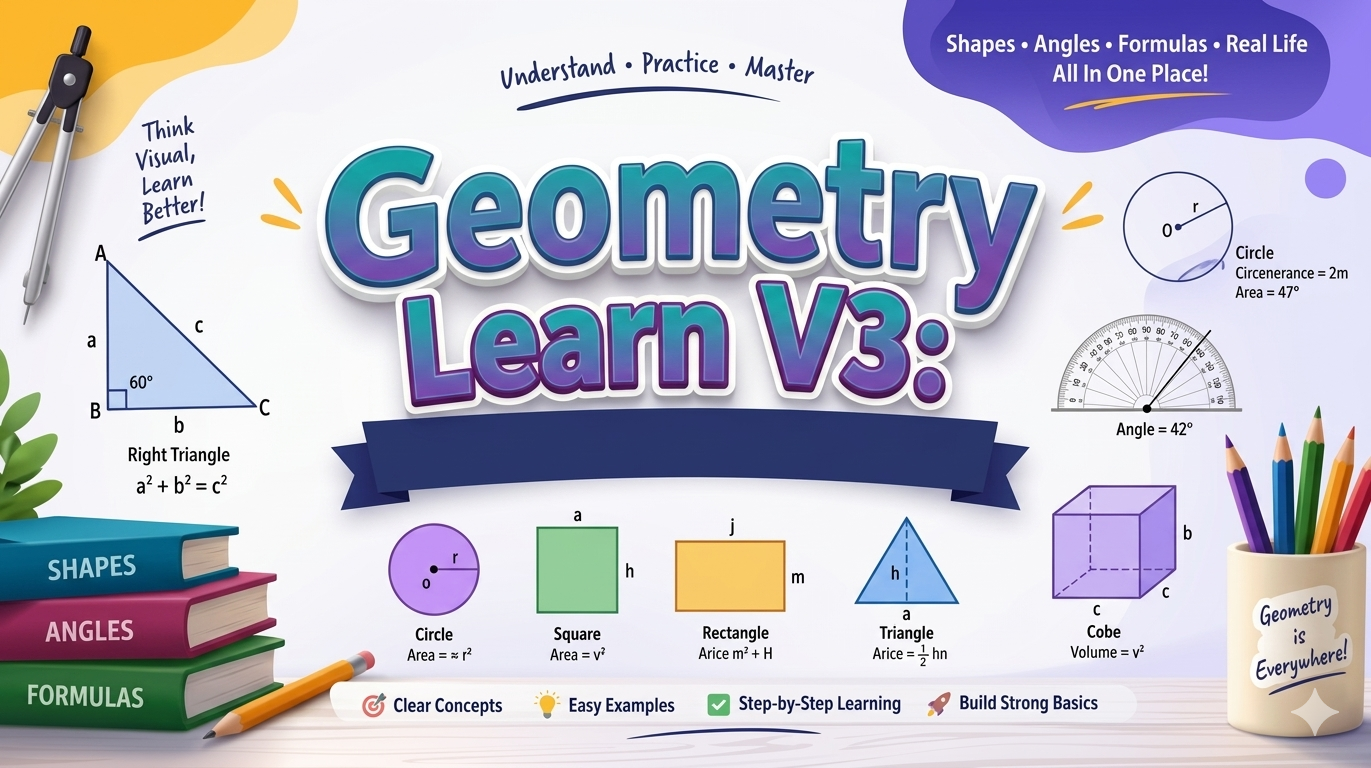
Geometry is often the first time students move away from the comfort of numbers and into the abstract world of logic and visual reasoning. Whether you are a high schooler struggling with proofs or an adult looking to sharpen your spatial intelligence, Geometry Learn V3 represents the modern standard for understanding the laws of our physical world.
The “V3” approach focuses on three core pillars: Visual intuition, Verifiable logic, and Versatile application. By moving past rote memorization, this framework allows you to see the hidden patterns in everything from architecture to the stars.
What is Geometry Learn V3?
At its heart, Geometry Learn V3 is an educational philosophy designed to bridge the gap between theoretical math and practical reality. Traditional methods often throw formulas at students without explaining why they work. V3 changes that by prioritizing the “why.”
In this version of learning, we treat geometry not as a list of rules, but as a language. Once you speak the language of points, lines, and planes, the universe starts to make a lot more sense.
The Evolution of Geometric Study
-
V1: Rote Memorization. Learning formulas like $A = \pi r^2$ without context.
-
V2: Problem Solving. Applying formulas to textbook problems to get an answer.
-
V3: Conceptual Mastery. Understanding the relationship between shapes and using that knowledge to solve real-world design and engineering challenges.
The Fundamentals of Points, Lines, and Planes
Every complex structure starts with the basics. In Geometry Learn V3, we refer to these as the “undefined terms” because they are the building blocks for everything else.
1. Points
A point has no dimension; it simply indicates a location in space. Think of it as a coordinate on a GPS.
2. Lines
When you connect two points, you get a line. In geometry, a line is infinite in both directions. If it stops, we call it a line segment.
3. Planes
A plane is a flat, two-dimensional surface that extends forever. Understanding planes is crucial for 3D modeling and architecture.
Exploring Polygons and Their Properties
Polygons are closed 2D shapes made of straight line segments. Geometry Learn V3 categorizes these based on their sides and angles, but more importantly, it looks at their symmetry and congruence.
Triangles: The Strongest Shape
Triangles are the rock stars of geometry. They are the only polygon that is inherently rigid, which is why you see them in bridges and roof trusses.
-
Equilateral: All sides and angles are equal.
-
Isosceles: Two sides are equal.
-
Scalene: No sides are equal.
Quadrilaterals and Beyond
From squares to trapezoids, quadrilaterals define our daily environment. The Geometry Learn V3 method teaches you to identify these shapes by their properties rather than just their appearance. For example, every square is a rectangle, but not every rectangle is a square.
The Power of Circles and Pi
Circles are unique because they aren’t made of straight lines. This introduces the concept of Pi ($\pi$), the mathematical constant that represents the ratio of a circle’s circumference to its diameter.
In Geometry Learn V3, we don’t just use $3.14$. We explore how circles relate to rotation, frequency, and even the physics of orbits. When you understand the circle, you understand the cycle.
Understanding Area and Perimeter in Geometry Learn V3
Calculating the space inside and around a shape is one of the most practical skills you can learn. Whether you are tiling a floor or fencing a yard, Geometry Learn V3 makes these calculations intuitive.
Quick Formula Reference
| Shape | Perimeter/Circumference | Area |
| Square | $4s$ | $s^2$ |
| Rectangle | $2l + 2w$ | $l \times w$ |
| Triangle | $a + b + c$ | $\frac{1}{2}bh$ |
| Circle | $2\pi r$ | $\pi r^2$ |
The Logic of Geometric Proofs
For many, proofs are the “final boss” of math class. Geometry Learn V3 demystifies proofs by treating them like a legal case. You start with Givens, use Postulates (accepted truths), and reach a Conclusion.
Deductive Reasoning
This is the process of using logic to draw a specific conclusion from general rules. If all humans are mortal, and Socrates is a human, then Socrates is mortal. In geometry, we apply this to angles and side lengths.
3D Geometry: Surface Area and Volume
Moving from 2D to 3D is where Geometry Learn V3 really shines. This is the realm of Prisms, Pyramids, Cylinders, and Spheres.
Understanding 3D space is vital for careers in:
-
Engineering: Calculating the load-bearing capacity of a structure.
-
Manufacturing: Determining how much material is needed for packaging.
-
Video Game Design: Creating realistic environments and character hitboxes.
Real-World Applications of Geometry Learn V3
Why do we learn this? Geometry isn’t just a school subject; it’s a tool for survival and innovation.
Architecture and Construction
Every building you see is a symphony of geometric principles. From the right angles of a skyscraper to the arches of a cathedral, geometry ensures that structures stand tall and withstand the elements.
Your phone knows where you are because of triangulation. By measuring the distance between your device and three different satellites, geometry can pinpoint your exact location on Earth.
Art and Design
The Golden Ratio is a geometric proportion that humans find naturally beautiful. Artists like Leonardo da Vinci used geometry to create balance and harmony in their masterpieces.
Tips for Success with Geometry Learn V3
If you want to excel in this field, you need to change how you study. Here are a few tips to master Geometry Learn V3 quickly:
-
Draw Everything: Don’t just look at a problem. Sketch it out. Visualizing the angles helps your brain process the logic.
-
Learn the Vocabulary: Geometry has a specific language. Words like adjacent, vertical, and supplementary have very precise meanings.
-
Relate to Reality: When you see a stop sign, think “Octagon.” When you see a pizza, think “Sector of a circle.”
-
Practice Proofs Early: Don’t wait until the exam. Practice small logic chains every day.
The Future of Geometry: Digital and Beyond
As we move further into the 21st century, Geometry Learn V3 is becoming increasingly digital. Tools like GeoGebra and AutoCAD allow us to manipulate shapes in virtual space, testing theories instantly without needing a compass and protractor.
Virtual Reality (VR) is also changing the game. Imagine walking inside a 4D tesseract or dissecting a complex polyhedron with your hands in a digital lab. This is the next frontier of geometric education.
Conclusion: Embracing the Geometric Mindset
Mastering Geometry Learn V3 is about more than passing a test; it’s about developing a new way of seeing. When you understand the relationships between shapes, the world becomes a more organized and beautiful place. You start to see the logic in the leaves of a tree, the efficiency in a beehive, and the grandeur in the cosmos.
Geometry is the bridge between the abstract mind and the physical world. By embracing the V3 method, you are equipping yourself with a timeless toolkit for problem-solving that will serve you in any career or hobby you choose to pursue.
Frequently Asked Questions (FAQs)
1. How is Geometry Learn V3 different from standard high school geometry?
Geometry Learn V3 emphasizes conceptual understanding and real-world application over the traditional “memorize and repeat” method. It integrates digital tools and focuses on spatial reasoning skills that are applicable in modern tech and design industries.
2. Is geometry harder than algebra?
It depends on how your brain works! Algebra is more algorithmic and follows a set of steps. Geometry is more visual and logical. Many people who struggle with “X and Y” find that they excel in geometry because they can actually see what they are working on.
3. Do I really need to learn proofs?
Yes! While you might not write a “two-column proof” in your daily job, the deductive reasoning skills you learn from proofs are essential for law, coding, medicine, and any field that requires clear, logical thinking.
4. What are some good tools for learning geometry?
Aside from the Geometry Learn V3 framework, tools like GeoGebra, Desmos, and even basic 3D modeling software like Blender are fantastic for visualizing complex geometric concepts.
5. Can geometry help me in a non-math career?
Absolutely. Graphic designers use geometry for layouts, chefs use it for portioning and presentation, and even athletes use it to understand angles of movement and trajectory. It is truly a universal skill.
