
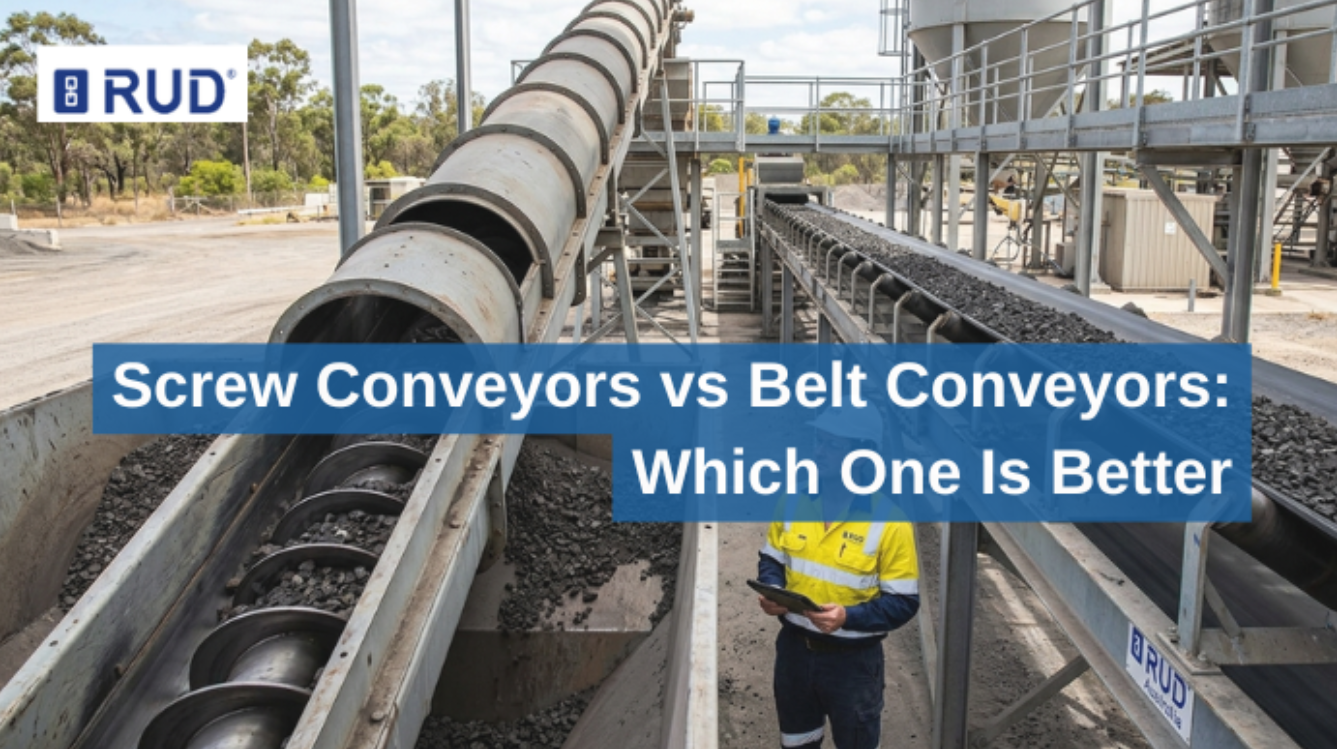
Screw conveyors and belt conveyor systems both move bulk materials, but they’re built for completely different jobs. One uses a rotating screw inside a tube to push material along, while the other relies on a continuous belt stretched over pulleys to carry loads across a distance.
At RUD Australia, we’ve worked with mining operations, grain handlers, and manufacturing plants across Brisbane and regional Queensland for over 40 years. We’ve seen what works reliably under pressure and what breaks down when conditions get tough.
This article breaks down when each conveyor system makes sense so you can choose the right materials handling solution for your operation. We’ll cover how they’re built, where they perform best, and what to consider before you commit to either system.
What Are Screw Conveyors and How Do They Work?
A screw conveyor is a mechanical system that uses a rotating helical screw blade inside a tube to move bulk materials from one point to another. The screw (also called a flight or auger) spins inside a U-shaped trough or fully enclosed tube, which pushes materials forward as it rotates. This design keeps powders, granules, and semi-solid materials contained during transport.
What’s more, its enclosed design keeps dust contained and prevents spillage. That containment becomes important when you’re handling fine powders or temperature-sensitive materials. You won’t see materials escaping into the air or spilling onto the floor like you might with open conveying systems.
That’s exactly why food processing plants, cement facilities, and pharmaceutical manufacturers rely on screw conveyors to keep their products clean and contained.
They work best for controlled feeding into mixers, batching plants, or dosing systems where precision counts more than speed. The spiral motion moves materials at a steady, controlled rate rather than rushing them through at high velocity.
Belt Conveyor Systems Explained
A belt conveyor system is a continuous loop of material (usually rubber) stretched over pulleys that carries bulk materials horizontally or at an incline across a distance. The belt runs over a series of rollers called idlers, which support the weight and keep the belt aligned as it moves. A motor-driven pulley at one end powers the system, while a tail pulley at the other end maintains tension.
When it comes to throughput, belt systems move large volumes quickly over long distances with minimal power consumption per tonne moved. They handle materials efficiently across horizontal runs, inclines, and declines without requiring multiple transfer points. One belt can transport materials several hundred metres without stopping.
That’s why mining sites, quarries, and port operations across Australia rely on belt conveyor systems. They handle abrasive materials and run continuously with minimal downtime. The open design makes them easy to inspect and maintain while the system keeps running.
Screw Conveyors vs Belt Conveyors: Key Differences
The main difference between screw conveyors and belt systems comes down to how they’re built and what materials they can handle reliably. But you can’t ignore cost, maintenance requirements, and site constraints when choosing between them.
Let’s break down what separates these two conveyor systems in real-world applications.
Material Handling Capacity
Screw conveyors suit smaller volumes and controlled feed rates, typically handling 50 to 500 tonnes per hour, depending on size. In contrast, belt systems excel at moving huge throughput quickly, with some mining installations shifting over 10,000 tonnes per hour.
Geoscience Australia reports that Australian mining operations across 350+ sites handle varying material volumes, with belt systems dominating high-volume applications. Material type also plays a role. Sticky clay clogs belts but moves fine through enclosed screws, while coarse rock wears screw flights down fast.
Cost and Maintenance Requirements
Screw conveyors cost less upfront, but wear parts like flights and bearings need replacing more often under abrasive conditions. Belt systems work differently here. They require a higher initial investment for support structures, but maintenance intervals stretch longer when properly aligned and tensioned.
What else you must consider is downtime patterns. You can patch a belt trackside in hours, but screw repairs often mean pulling the whole unit apart.
Space and Installation Needs
Screw conveyors fit into tight spaces and run vertically or at steep angles where floor space is limited. Spiral conveyors take this even further by lifting materials vertically with a minimal footprint.
Meanwhile, belts need room for support structures, walkways, and tensioning equipment along their full length. On the installation side, screws bolt into existing layouts without major structural work, which makes them simpler to fit into tight spots.
Durability in Harsh Environments
Enclosed screw systems protect material from dust, moisture, and contamination better than open belt configurations. On the other hand, belt conveyors tolerate abrasive materials without the internal friction that wears screw flights and shafts down over time.
Temperature extremes affect each system differently. Heat-resistant belts exist, but enclosed screws handle dusty or corrosive conditions more reliably. For this reason, industries like cement manufacturing and pharmaceutical production often choose screw conveyors for controlled environments where contamination control is non-negotiable.
When Should You Use a Screw Conveyor?
A screw conveyor is a must when you’re handling fine powders, dusty materials, or anything that needs to stay enclosed during transport. You’ll also need one when precise feed control counts more than speed.
Here are three situations where screw conveyors outperform belt systems:
- Handling Fine Or Dusty Materials: Flour mills, cement plants, and pet food manufacturers use screw conveyors because the enclosed trough prevents spillage and keeps dust contained. The sealed design stops contamination during transport from one point to another location.
- Precise Dosing And Batching: Pharmaceutical companies and beverage producers rely on screw systems to meter ingredients at controlled speeds into mixing equipment. Variable speed drives let you adjust feed rates down to single-digit percentages for exact ratios.
- Tight Spaces And Vertical Lifts: Spiral conveyors lift materials vertically with minimal footprint, which works well in packaging facilities where floor space comes at a premium. Standard screw designs also fit under hoppers and between existing equipment where belts won’t operate.
Pro tip: If your material tends to pack or bridge inside hoppers, pair your screw conveyor with a vibrating feeder at the inlet to keep flow consistent.
When Does a Belt Conveyor System Make More Sense?
Belt systems make sense when you need to move large volumes quickly without degrading the material in the process. They handle fragile materials like grain or pellets gently without crushing them during transport, unlike screws that can break particles under pressure.
The continuous belt motion keeps materials moving smoothly without the grinding action you get from rotating screw flights.
In our experience, Australian mining and quarrying operations favour belts because they tolerate abrasive rock and ore while running 24/7 with minimal crew intervention. Belt conveyors also work well when you’re moving pallets, cartons, or packaged goods in automotive and logistics facilities. The flat belt surface carries these items across a distance without damage.
If you need to transport heavy loads over several hundred metres, belt systems deliver better efficiency than multiple screw conveyors linked together. One belt can replace three or four screw units, which cuts down on transfer points and reduces power consumption per tonne moved.
Choosing the Right Conveyor System for Bulk Material Handling in Australia
Since you now understand how each system works and where they perform best, here’s what to consider before making your final decision. Start by assessing your material characteristics: particle size, moisture content, abrasiveness, and whether contamination control is important for your operation.
Below are some quick overviews in a table:
| Factor | Screw Conveyors | Belt Systems |
| Best for | Fine powders, enclosed handling | High volumes, long distances |
| Space needs | Compact, vertical lifts | Requires support structures |
| Maintenance | More frequent wear parts | Longer intervals |
| Cost | Lower upfront | Higher initial investment |
Safe Work Australia notes that managing risks around bulk material handling equipment is essential to prevent musculoskeletal disorders in industrial workplaces.
However, Australian sites often deal with extreme heat, dust storms, and moisture swings during the wet season, so durability under harsh conditions isn’t optional. Industries ranging from mining to food manufacturing need conveyor systems engineered to handle local conditions reliably.
Finding the Right Fit for Your Operational Excellence
Screw conveyors and belt conveyor systems each have strengths depending on what materials you’re moving, where they’re going, and how much volume you need to shift. In fact, neither system works for every job, but once you know which one fits your operation, you avoid wasting money on the wrong equipment.
So getting the conveyor system choice right upfront saves you money and downtime over the equipment’s working life. The wrong materials handling solution means constant repairs, production slowdowns, and operational problems that compound over time across your facility.
RUD Australia supplies both screw and belt conveyor systems engineered for Australian industrial conditions. Our team has worked across mining, manufacturing, and bulk handling operations throughout Queensland and beyond.
Talk to us about what conveyor solutions suit your site, and we’ll help you deliver the right system for your business operations.
